

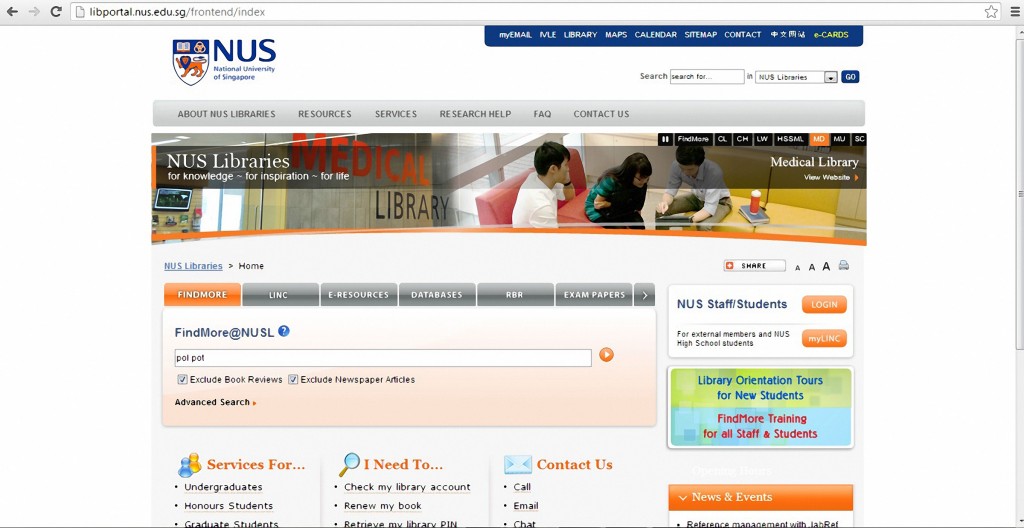

It’s probably too early to worry about term papers but here’s a piece of good news! NUS Library has recently launched FindMore@NUSL, their brand new search engine, which will make writing our term papers and lab reports a whole lot easier.
Writing a term paper is a long and laborious process, involving detailed research using academic sources from all over. Do you start with books available in the NUS library or do you start with the online journals and newspapers that NUS subscribes to? If it’s the latter, which one?
Having heard enough complaints from students every semester, NUS Library was inspired to come up with FindMore@NUSL. It promises a less painful research process through the integration of existing library sources, our institutional repository, and the online journal and newspapers that NUS subscribes to into one super search engine. Simply put, it saves us the hassle of manually searching through ScholarBank@NUS for masters, PHD theses and dissertations written by NUS students and the other 160 million journal and newspaper articles that we have access to. It is no wonder that this was the second most requested feature in the 2007 survey on the functionalities of the library catalogue.
In addition, FindMore@NUSL also boasts a search response faster than Google, a remarkable improvement from its popular precursor, InfoGate.
An obvious downside to integrating such a huge amount of sources into one search engine is the colossal amount of search results it generates. The team behind FindMore@NUSL has thoughtfully crafted up really useful filters, through analysing common user behavior and preferences, to help us narrow down the search results into a more manageable size. Need only peer-review journal articles? Simply check the box. Want only articles with full-text available online? Here you go.
Lastly, for the special group of muddleheads who forget their sources after happily using them, FindMore@NUSL’s brand new Match Full-Text in Book function is your saviour. Instead of frantically going through all your sources again two hours before the dateline, you can simply key in the exact phrase or sentence into FindMore@NUSL and it would run a search through its entire print and e-book collection to give you the exact source down to the page number. No more excuses for sloppy citations!
The system is not perfect yet and given the relatively new technology adopted and the size of data involved, there are bound to be certain flaws here and there. NUS libraries will continue to enhance FindMore@NUSL and smooth out the kinks and knots along the way. To better the service, they would love to hear more from us – because it is, after all, designed for us.