

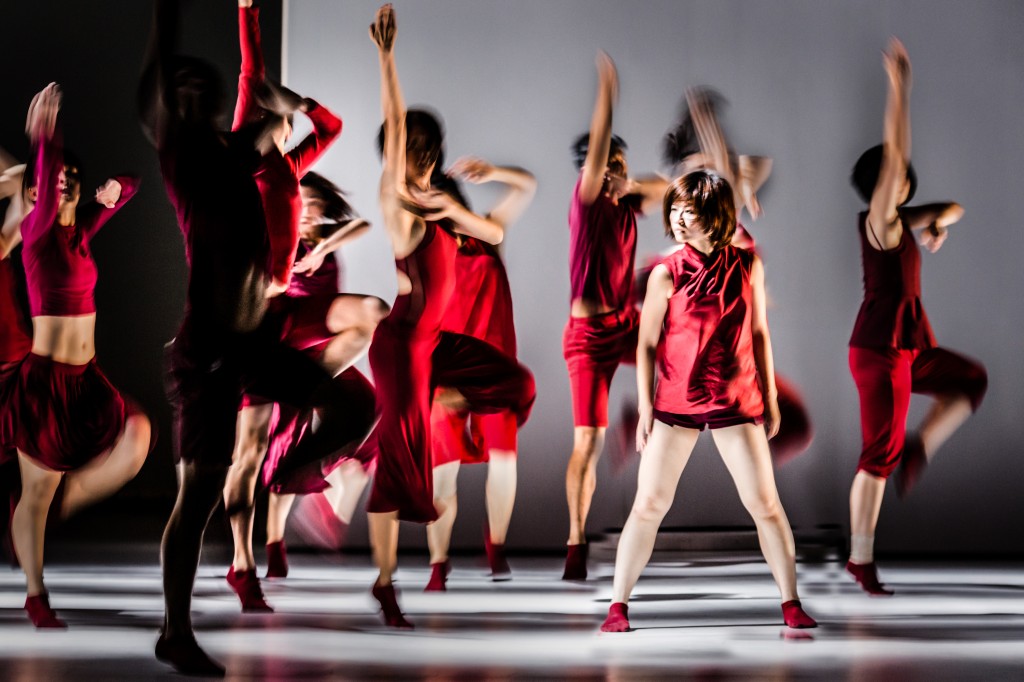

Re: Dance Theatre (RDT), a budding local dance company, was founded in 2012 under the artistic direction of Albert Tiong, who is currently also the technique tutor of NUS Dance Synergy. It was therefore only natural for the two groups to collaborate, and so Traces was birthed. Traces is based on the The Other Shore, a play by Nobel Laureate Gao Xing Jian. The controversial play tells of its characters’ journey of crossing the river of life to reach Nirvana (“the other shore”), only to find that it does not exist. The play was banned in China due to its bold anti-Communist theme.
Marked by choreographer Albert Tiong’s signature style, the entire piece featured seamless, circular movements heavily influenced by Chinese dance. The piece opens with a stare-down confrontation between the group and an individual soloist—as if straight out from a Chinese gong fu movie, the group of dancers and the solo dancer circle each other, maintaining eye—but not physical—contact. This sets the stage for the search for the other shore, a journey rifled with constant tensions and struggles (between individuals, and between the individual and society).

An on-going battle ensues: the soloist makes her attack against the group, the group retaliates, they fall, they rise, and finally, individuals break out from the ‘they’. The focus then shifts to individual relationships: competition, betrayal and even indifference. In a particular segment on a kind of love-hate relationship, two seemingly sparring dancers are suddenly separated by a wall, and a deep sense of loss ensues as they try to feel for each other from behind the wall that divided them. Yet, admittedly these interpretations of the dance were not immediately apparent and perhaps alienated some members of the audience.
The collaboration between RDT and synergy was set to be exciting. Yet, the contrast between the two groups of dancers was painfully obvious. It was disappointing that with exception of two Synergy members, Jeryl Lee and Jerry Goh who both deserve special mention, the other student dancers seemed like mere wallflowers, bodies filling up space on the stage without contributing much to the development of the dance. To a certain extent, it felt like an RDT show (with the naturally brilliant execution of movements by RDT dancers) more than a collaboration. It seemed that the audience were set to expect a built-up to a grand finale involving the entire cast that did not occur. The ending felt abrupt, leaving the audience expecting more. Yet, perhaps it was exactly this sense of incompletion and disappointment that the dance was trying to convey – crossing the river of life only to find a non-existent Nirvana. Through this journey of constant struggle, the audience were forced to question what makes life meaningful and if we, in our own lives, were fighting for things that are worthwhile.