

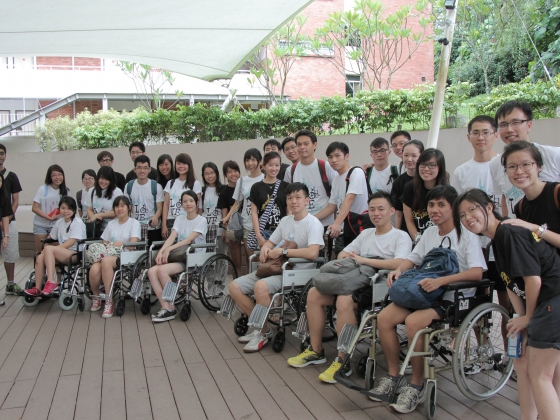

Recently, NUS student group NUS Enablers organised Wheelathon 2013 to raise awareness for disabled students. The main focus of the Wheelathon was for able-bodied students to experience, through a series of games and obstacles with one group member on a wheelchair, the difficulties faced by wheelchair students navigating around the hilly terrain. As a special needs student myself, I am all the more heartened by this initiative, and it prompted me to ruminate further on how special needs students can feel more integrated in the school community given the limitations faced on a daily basis.
First off, I believe it is pertinent to note that each special needs student’s physical condition varies from person to person, and that we should not simply generalise and lump them altogether. It is a similar mindset to that of how each individual is unique and has his/her own set of abilities and talents. From my experiences, I have received negative, snide, oversimplified remarks about my capabilities just because I exhibit certain physical limitations. While I appreciate that Singapore is gradually evolving as an open society, from what I have observed there are nonetheless certain social stigma that remain deeply embedded, and there is still a long way to go towards achieving parity.
What some people fail to realise is that although some of us may be physically limited, we are still perfectly capable mentally. Stephen Hawking, a great scientist, is a prime example. Despite his debilitating motor neuron disease over the years, he has contributed significantly to the realm of science, physics and cosmology, where his most famous works include the framework of general relativity and the Hawking radiation theory. His list of accolades and achievements are staggering, made all the more remarkable given his degenerative physical condition. He may be one of the few to achieve such a high position, but he still represents the hope that non-able-bodied students can one day make their mark in society too.
Sometimes, it is also healthy to provide emotional, mental and spiritual support on top of physical aid. At times when situations seem bleak and dreary, friends step in and make your worldview more optimistic. Drawing on my own personal experience once more, I realize that I have found in university – as diverse as it can get – a group of friends I can call tightly-knit at the residential college I stay in, College of Alice and Peter Tan (CAPT) in University Town. I cannot express how infinitely thankful I am for this bunch of friends who encourage me when I am feeling dejected, who take time to listen to my woes, and to simply be there whenever I need them. In turn, I have emerged stronger, better, worthier, and a reciprocal relationship develops where I reach out to others just as people have done so to me. Having a supportive community is important to everyone, but even more so for those that face greater challenges in life.
Being a part of one of the global leading institutions, I feel it is also important to develop one’s character on top of academics. Organizing the Wheelathon 2013 was not merely to raise awareness for the disabled. It also promotes the active citizenry spirit, inspiring other NUS students to hold similar events in future; it is only when people participate in such an event, or when they see it happening, do they start to realize the difficulties faced by wheelchair users. As project director of Wheelathon 2013, Annie Lim, 20, a student from the Faculty of Arts and Social Sciences says, “Through this activity, we’re hoping more able-bodied students will be willing to lend a helping hand when they see special needs students. I don’t think that most people have enough interaction with special needs students to fully understand their situation.” Thus, it is when they begin to understand the challenges that they will pass on the message. At times like this, when students step up to support their peers, it instills in them a sense of compassion and kindness, forming a warm, welcoming and valuable community.
Integrating the special needs in society is complex and often requires concerted effort from various groups such as the government, community, school, friends and family. Similarly, the physically underprivileged also need to realize that they have the right to access information and assistance. Let’s work in tandem to push for a better, more cohesive society.
“Through this activity, we’re hoping more able-bodied students will be willing to lend a helping hand when they see special needs students. I don’t think that most people have enough interaction with special needs students to fully understand their situation.”