

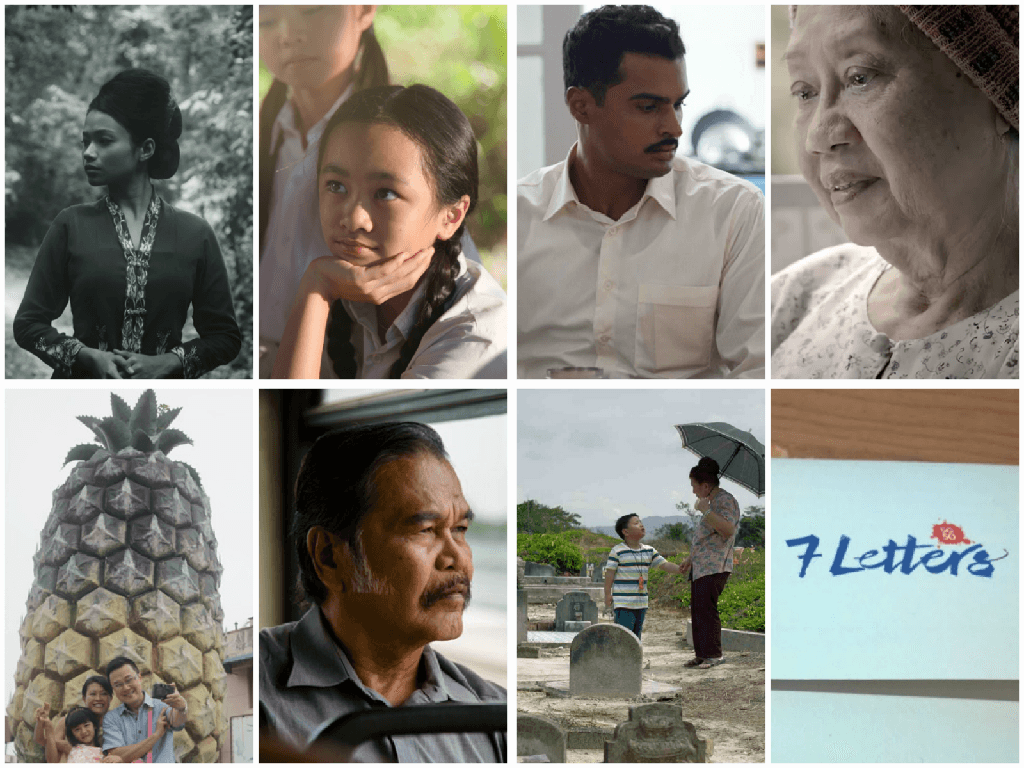

Give a group of top directors the necessary freedom and fund to express their creativity. What you get is a work of genuine love and highest quality: 7 Letters.
Not only has it garnered rave reviews from both critics and the public at large, the film will also see its international premiere at the Busan International Film Festival in October 2015.
The film’s star power with the giants in Singapore film industry such as Eric Khoo, Jack Neo and Royston Tan has been unmistakable, not to mention an easy-to-miss cameo by Oscar-winning actress Juliette Binoche as well as the use of a song by music maestro Dick Lee, who was in attendance at the National Day weekend screening at the National Museum.
Our writer Ignatius Albert looks at how the film has become a crowdpleaser beyond its star power – from its marketing strategy to its interrelated themes – that have endeared it to the Singaporean audience.
Don’t know what 7 Letters is about? Check out The Ridge‘s tl;dr review of the seven letters, and how they each offer a unique slant on the Singaporean heartbeat.
A limited release: an ingenious marketing strategy
It is interesting to note that 7 Letters was initially given only a limited release, in what might have been an ingenious marketing strategy by the producers.
The film had its three-day gala screening between 24 and 26 July at the Capitol Theatre, receiving the honour of being the first to be played there after its reopening this year. At that time, there was reportedly no plan to give the film a commercial release.
However, the overwhelmingly positive reception encouraged its extended screening in early August at the National Museum on a donate-as-you-wish basis.
Likewise, these SG50 weekend screenings received strong support from the public, as evidenced by how the tickets were snapped up within two hours by members of the public queuing up for them – including this writer, who had the privilege of meeting the director-producer Royston Tan at the 8 August screening.

It is tempting to wonder whether the producers had indeed intended to build up the public anticipation by creating an aura of “exclusivity” through the gala and limited screenings.
Because true enough, the word-of-mouth advertising has succeeded to give the film a commercial release through Golden Village, which has received two further extensions to September 9 (as of press time).
Whether or not this was indeed a marketing ploy, it definitely worked.
On change, loss and Singapore
Many of the short films revolved around the search for long-lost loves or family members, how much Singapore has changed and – in the process – how much it has lost.
The familial and national context were well juxtaposed to invite the audience to reflect on how we have grown up (and grown old) along with Singapore – and made all the more poignant with the SG50 celebrations.

For instance, Boo Junfeng’s short “Parting” involved an old Malaysian man searching for a sweetheart from his past. Visiting Singapore for the first time after many years, he had planned to alight at the Tanjong Pagar Railway Station – without knowing that it had in fact ceased operations.
Similarly, Kelvin Tong’s “Grandma Positioning System (GPS)” featured a family who makes an annual visit to their late grandfather’s tomb. The contrast between the ah ma’s impassioned monologues with her long-dead husband, and the family’s distracted busyness and indifference reflects the changing attitude towards elders and between the older and younger generations of Singaporeans.
Most importantly, the ah ma’s long passages consisted of details of the gradual, minor yet accumulating changes in Singapore’s landscape, ranging from the closing of hawker centres to the opening of new estates.
Listening to her heart-wrenching words, one cannot help but to recall the feeling of loss towards the buildings and persons of Singapore’s past, now gone forever.
All these beg the question: Has the change been worth all the losses? It is a perennial question that holds true for all nations and generations, not just for Singaporeans in 2015.
Speaking in our four national tongues
Nearly all of the dialogue in the seven shorts were spoken in either Mandarin, Tamil or Malay. This was probably to reflect the time scope of the storylines, some of which were based in the early years of Singapore, such as Jack Neo’s “That Girl.” In other shorts like K Rajagopal’s “The Flame,” the storyline took place in a familial context, where it is common between family members to speak in their mother tongue. The main characters in some shorts were also older persons, who might not have been able to speak English.

In fact, all three theme songs in 7 Letters were largely in Mandarin and Malay: “Kembali” performed by actress Nadiah M. Din, “Bunga Sayang” written by Dick Lee, as well as “Precious” by songstress Serene Koong.
The trio of medleys create an unmistakably Singaporean ambience, and the fact that the lyrics are written in local mother tongues helps to boost their bona fide feel.
While “Bunga Sayang” is largely written in English, its Malay title became the centre of Royston Tan’s short on the unlikely connection between a Malay makcik and a Chinese schoolboy.
Indeed, these songs served as a bridge for Singaporeans to relate to the storylines, regardless of racial and linguistic backgrounds, for beauty knows no such bounds.
In fact, having grown up accustomed to Mandarin, Malay and Tamil languages in spite of our lack of understand, hearing these languages can even become endearing to us.
Our brethren across the border

A whopping six out of the seven shorts either had a major Malay character, are based in or shot in Malaysia.
The films by Eric Khoo, Boo Junfeng and Royston Tan starred Nadiah M Din, J.A. Halim and J Rosmini as the pontianak, the pakcik with dementia and the kuih makcik; while other shorts by Jack Neo, Tan Pin Pin and Kelvin Tong were shot in Malaysia: in a rustic village, the town of Pekan Nanas and a Chinese cemetery respectively.
Such overrepresentation signifies how even 50 years into Singapore’s nationhood, our ties with Malaysia and the region are bound to last.
Nonetheless, the frequent use of Malaysia as a shooting location reveals significant changes in Singapore as seen in the theme of change and loss. Why did Jack Neo have to shoot the kampong scenes, or Kelvin Tong shoot the Chinese cemetery, in Malaysia?
Because such places are becoming such a rarity in Singapore.
And this signifies how these three recurring themes – on change and loss, our national languages, and the overrepresentation of Malays and Malaysia – are intertwined, with the ‘7 letters’ bound by the common threads of Singaporean stories from the heart.
These three themes combined well with the star power and top-quality work to produce a beautiful anthology, forming a proper tribute to Singapore and its celebration of its fiftieth year.
Want to find out more? Check out The Ridge‘s tl;dr reviews of the seven letters here!